Small celebration at home
The familiar environment provides security. Toys, changing station, sleeping arrangements, and spare clothes are directly available. For many one-year-olds, this is the most relaxed solution.

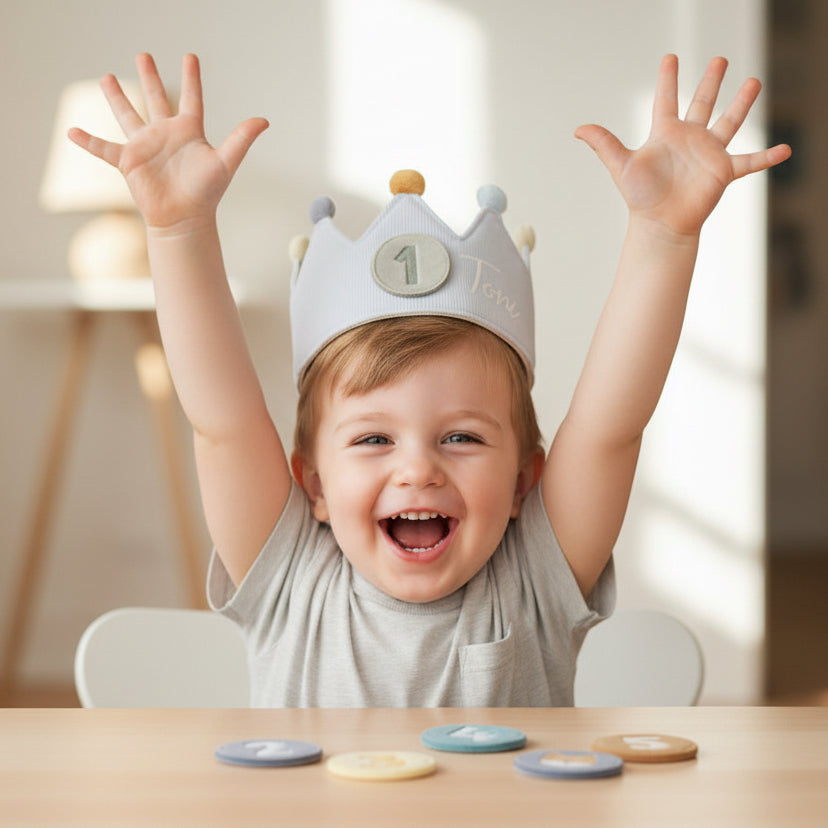
The 1st birthday is a special milestone: a whole year full of firsts is behind you. Perhaps the first teeth were admired, the first steps were taken, and countless small developmental steps were celebrated. The birthday should therefore be special - but it doesn't have to be perfect or elaborate.
In this comprehensive guide, you'll find a complete plan for the first children's birthday: from the guest list and invitation to decorations, food, and games, as well as rituals, gift ideas, photo opportunities, and a practical checklist.
For the child itself, the first birthday is initially a beautiful day with familiar people, new impressions, and perhaps a special cake. For parents and family, it often means even more: it marks the end of an intensive first year of life.
In just twelve months, a curious toddler has developed from a newborn. Some children crawl, others are already walking, some speak their first words, and still others observe calmly. These differences are completely normal. The celebration should therefore not be guided by expectations, but by the individual developmental stage and temperament of the child.
Even if a one-year-old will probably not consciously remember the day later, photos, videos, a birthday ritual, and personal mementos will remain. That's precisely why it's worth consciously choosing a few details – and keeping everything else as uncomplicated as possible.
There isn't one right way to have a birthday party. What matters is what suits your child, your daily routine, the season, and your spatial possibilities.
The familiar environment provides security. Toys, changing station, sleeping arrangements, and spare clothes are directly available. For many one-year-olds, this is the most relaxed solution.
A shared breakfast or an early brunch works particularly well if the child is well-rested in the morning and takes their nap later.
A celebration after the midday nap can be well planned and time-limited. The effort remains manageable and the format is easy for guests to understand.
A trip to the animal park, a farm, a walk in the woods, or a picnic can be nicer than a classic party – especially for families who want to celebrate quietly.
In good weather, a garden offers plenty of space to move around. Shade, a child-safe environment, and a weatherproof backup plan are important.
For a large family, two short visits can be more pleasant than a crowded room with many voices, gifts, and expectations.
The ideal number of guests depends less on a fixed number and more on how many people your child can comfortably handle at once. Some children enjoy attention, while others react quickly to new voices and crowded rooms with restlessness.
It is not necessary to invite all relatives, friends, and acquaintances at once. The first birthday is not a social obligation. A small circle is often more personal and makes it easier for parents to participate in the event themselves.
The birthday child's daily rhythm is more important than a traditional party time. Plan the celebration to avoid coinciding with their usual nap times and consider when the child typically gets hungry.
Well suited for children who are awake and well-rested in the morning. Breakfast or brunch can start around 9:30 or 10:00 AM.
Often particularly practical: Start after the midday nap, for example around 2:30 or 3:00 PM, with a clear end in the early evening.
For many one-year-olds, about one and a half to two and a half hours is sufficient. This is not a rigid rule, but a practical guideline. Observe the child: tiredness, turning away, crying, strong clinging, or frantic behavior can be signs that they need a break.
A rough schedule provides orientation but should always be adaptable to the child's mood.
| Time | Program item | Why this makes sense |
|---|---|---|
| 2:30 PM | Arrival and free play | The child can slowly get used to the guests and the changed atmosphere. |
| 3:00 PM | Cake and drinks | Everyone sits together briefly without the child having to sit still for a long time. |
| 3:30 PM | A small ritual or family photo | The most important memory moment takes place before fatigue sets in. |
| 3:45 PM | Free play or a simple activity | No fixed program, but movement and discovery at one's own pace. |
| 4:15 PM | Unpack some gifts | Gifts are consciously perceived without overwhelming the child with many packages. |
| 4:30 PM | Quiet ending | The celebration ends relaxed and not abruptly. |
Not all gifts need to be opened during the celebration. Some families open only one or two gifts together and save the rest for the coming days. This gives the child more time to get to know each new toy.
For a small family celebration, a personal message is sufficient. A printed invitation, however, can become a beautiful keepsake.
Our little miracle turns 1!
We would love to celebrate this special first year with you. Join us on [Date] from [Time] until approximately [Time]. We look forward to a relaxed afternoon with cake, games, and many beautiful memories.
Please let us know by [Date] if you can make it.
A specified end time helps everyone involved. Guests know how the afternoon is planned, and parents don't have to spontaneously explain the right moment to conclude.
Good birthday decorations don't require a big budget. For photos and atmosphere, a few carefully selected elements often work better than a multitude of small decorative items.
Hang twelve pictures – one from each month of life. This makes the first year visible and the decoration very personal at the same time.
A fabric or paper bunting quickly creates a festive atmosphere and can later be reused in the children's room.
A large number made of wood, cardboard, flowers, or fabric makes for an eye-catcher and photo backdrop.
A small table with cake, flowers, a birthday train, and a photo of the child is often enough as a decorative centerpiece.
Two or three harmonious colors create a calm overall picture. Natural tones, sage green, beige, pink, blue, or warm rainbow colors are easy to combine.
Fabric banners, wooden numbers, a birthday crown, or a birthday train can remain part of family tradition for many years.
A theme is not a must. However, it can help to quickly coordinate colors, cake, invitations, and decorations. It's best to choose a theme that suits the family, the season, or the child's current interests.
A motto doesn't have to be applied to every detail. Often, a suitable invitation, a cake motif, and two decorative elements are enough to create a harmonious overall picture.
When it comes to food: keep it simple, familiar, and well-prepared. The first birthday is not the best time to try out numerous unfamiliar dishes at once. Offer the child foods they already know and can eat well.
The cake can look special, but it doesn't have to be overly sweet. Soft cakes with banana, applesauce, natural yogurt, or mild cream cheese are popular. The main thing is that the consistency suits the child and that it does not contain any hard-to-chew components.
Ripe banana provides natural sweetness and ensures a soft consistency.
Small muffins are easy to portion and can be served without elaborate decoration.
A small soft cake with yogurt cream is suitable as a photo motif and can be easily adapted to familiar ingredients.
Several small pancakes can be stacked with yogurt and soft fruit to create a simple birthday cake.
During a celebration, the familiar environment changes: doors are open, bags are on the floor, drinks are left unattended, and many adults feel responsible at the same time. Therefore, decide in advance who will keep an eye on the birthday child during the celebration.
Toddlers should sit upright and calmly while eating and be supervised by an adult. Avoid foods that are easily choked on or prepare them in an age-appropriate way.
Grapes and small tomatoes should not just be halved, but cut lengthwise into several narrow pieces. In general, preparation must always suit the child's individual developmental stage.
Check all toys offered for age recommendations, condition, and loose small parts. Older siblings or guest children may bring toys that are not yet suitable for a one-year-old.
One-year-olds don't need a classic children's birthday program. Free play, movement, and the closeness of familiar people are usually perfectly sufficient. Prepare at most one or two simple activities.
The first birthday is an ideal time to start a tradition that can be repeated year after year. Simple rituals, in particular, develop great emotional value over time.
Write down what the child learned in the first year, what they laugh about most, which songs they like, and which moments touched you. The letter can later be handed over along with photos and small souvenirs.
So that one parent doesn't spend the whole day behind the camera, you can ask a trusted person to capture some important moments. Prepare a small photo list beforehand and then put the smartphone away again.
Before sharing group photos, clarify whether other parents agree to the publication. Not every beautiful keepsake photo has to appear publicly on social networks. A private photo album or a protected family group can be a more suitable solution.
Good first birthday gifts are based on the child's developmental stage, invite exploration, and can be used for as long as possible. Products that don't just briefly surprise but are used again and again in everyday life are particularly valuable.
Plugging, rotating, and sliding elements encourage experimentation and often accompany the child over a longer period.
They can be sorted, stacked, rebuilt, and later integrated into imaginative play scenes.
As children become more mobile, pull-along toys and vehicles combine movement with independent discovery.
Joint viewing, naming, and feeling support quiet family moments and can become part of the evening ritual.
A soft companion can provide comfort and become a long-time favorite.
A product with a name combines practical or playful use with a personal memory of this special birthday.
Ask the parents about existing toys, wishes, and needed sizes. Several guests can also contribute to a larger gift. This prevents duplicate products and ensures that something truly suitable is chosen.
A personalized gift can connect the first birthday with the child's name for the long term. It is important that the personalization is clearly legible and carefully checked before ordering.
Schmatzepuffer has specialized in unique gifts for babies and children since 2011. Since 2017, we have been personalizing wooden products and wooden trains with names and individual details. Personalization is carried out in our manufactory in Bocholt.
A lovely birthday is possible on almost any budget. The biggest difference usually comes from the number of guests, catering, location, and newly purchased decorations.
| Budget | Possible Scope | Savings Tip |
|---|---|---|
| Up to approx. €50 | Small celebration at home with homemade cake and existing decorations | Use monthly photos, fabric scraps, and a handmade number as decoration |
| Approx. €50–100 | Cake, snacks, some reusable decorative elements, and a small activity | Buy only two to three high-quality decorative elements |
| Approx. €100–200 | Larger family gathering, more extensive buffet, and a special keepsake | Ask guests to contribute to the buffet |
| From approx. €200 | Rented venue, professional cake, photography, or a larger celebration | Check which expenses truly provide lasting added value |
The amounts are merely planning examples. A loving celebration does not depend on how much money is spent. Personal rituals, time, and attention usually leave a stronger impression than elaborate party items.
A crowded room can quickly become overwhelming for a one-year-old. A smaller group creates more peace and personal closeness.
A tired child cannot enjoy even the most beautiful decorations. Plan according to the daily rhythm first, and only then according to the adults' preferred dates.
One-year-olds do not follow a classic party plan. One or two small activities and plenty of free play are sufficient.
Many packages, voices, and new objects can be overwhelming. Distribute the unwrapping over several days if necessary.
Take family pictures and other important shots early, while the child is still rested and the clothes are clean.
Check all food from a one-year-old's perspective. What seems small and practical for adults may be unsuitable for toddlers.
Perhaps the child doesn't want to try the cake, wear the crown, or prefers to crawl during the group photo. Precisely these unplanned moments are part of a true family memory.
For many children, a small celebration in a familiar environment is ideal. Adjust the start and duration to the child's sleep and eating rhythm, invite only close caregivers, and forgo an extensive program.
There is no fixed ideal number. Parents, siblings, grandparents, and a few other trusted people are often sufficient. The key is how comfortable the child feels in larger groups.
Approximately one and a half to two and a half hours is a suitable timeframe for many families. At the first signs of fatigue or overwhelm, the celebration should be able to wind down calmly.
Start ideally after a sleep phase and not shortly before a usual meal. The early afternoon after the midday nap is often particularly suitable.
No. Free play, familiar toys, music, bubbles, or a small crawling course are completely sufficient. The child should always be able to decide for themselves what they want to do.
Offer familiar, soft, and age-appropriately prepared foods. Suitable options include soft bread, well-cooked vegetables, appropriately cut fruit, mild pancakes, or a soft cake with familiar ingredients.
Whole nuts, hard candies, uncut grapes, whole cherry tomatoes, hard raw vegetable pieces, and other easily swallowed foods are unsuitable. Food must always match the child's developmental stage.
A soft banana, apple, or yogurt cake is often well-suited. It should not contain whole nuts, hard decorations, or hard-to-chew components.
Motor skills toys, stacking toys, pull-along toys, large building blocks, books, cuddly toys, and selected personalized keepsakes are popular gift ideas. Always pay attention to the respective age recommendation.
No. If many gifts accumulate, some of them can be opened on subsequent days. This way, each gift receives more attention, and the child is less overwhelmed.
A family outing, a picnic, a visit to the petting zoo, a shared breakfast, or a quiet day at home with a small birthday ritual are wonderful alternatives.
Yes. A homemade cake, existing toys, a photo garland, and a few guests are perfectly sufficient for a personal celebration. The emotional value does not depend on the budget.
For basic information on nutrition and safe food preparation for toddlers, publicly available information from the Federal Centre for Nutrition and the Federal Institute for Public Health has been taken into account, among other sources.
Editorial status: July 2026. General advice cannot replace individual medical consultation.