
100 Important Postpartum Questions – Answers for the First Weeks with Baby
The first days and weeks with a newborn are full of love, but also full of questions. Many parents google at night, between two feedings, or while the baby sleeps in their arms. This guide answers the most common questions about the postpartum period, breastfeeding, sleeping, health, and daily life with a baby.
Why we can answer these questions
Since 2011, we at Schmatzepuffer have been dealing daily with topics related to birth, babyhood, christenings, and the first years of a child's life. During this time, we have crafted many personalized gifts and had thousands of conversations with expectant parents, grandparents, godparents, and families.
Many questions in this guide come from real family life: from messages, customer inquiries, conversations, and experiences concerning birth, the postpartum period, baby gifts, and special memories.
Within our team, many also know the first weeks with a baby from their own experience. This helps us understand the uncertainties that truly concern new parents – from sleeping and feeding to the question of which gift will become a lasting memory.
Important: We do not replace midwives, pediatricians, or any other medical professionals. In case of health problems, fever, feeding difficulties, breathing irregularities, or if you have an uneasy feeling, you should always seek professional medical help.
Our goal is to provide guidance, answer typical questions clearly, and give young parents a little more security in the first few weeks.
About Schmatzepuffer
Schmatzepuffer is a family-run specialist for personalized gifts for birth, christenings, and special milestones in a child's life. Many of our products are personalized with names, birth dates, times, sizes, or weights, making them lasting keepsakes.
Note: This guide was created with a special focus on practicality, experience, trustworthiness, and clear guidance.
Arriving Home & Postpartum Period
1. Is it normal to feel overwhelmed after birth?
Yes, that is very normal. After birth, everything suddenly changes: your body recovers, hormones shift, sleep is lacking, and at the same time, there's a tiny baby who needs you around the clock. Many mothers feel happy, unsure, exhausted, and emotional all at once in the first few days. This doesn't mean you're doing anything wrong. It just means you're going through one of the biggest transitional phases of your life. It's important to accept support and not try to function perfectly right away.
2. Why am I suddenly so emotional?
Many women experience strong mood swings in the first few days after birth. You might laugh, cry, doubt, and then feel full of love again the next moment. This is often due to the "baby blues": hormones, sleep deprivation, the birth experience, and new responsibilities all come together. However, if the sadness lasts longer, intensifies, or you feel empty, hopeless, or consistently overwhelmed, you should talk to your midwife, doctor, or pediatrician.
3. How much visitation is appropriate after birth?
Only as much as genuinely benefits you. The first few days at home are not a social event, but a postpartum recovery period. Visitors should stay briefly, be considerate, and ideally help: bring food, occupy older children, shop, or do laundry. If visitors stress you, it's okay to decline. A simple "We'll let you know when we're ready" is perfectly sufficient. Your body, your baby, and your peace and quiet take precedence.
4. Does my baby need to learn a fixed routine immediately?
No. A newborn does not yet have a fixed day-night rhythm. They live by hunger, closeness, tiredness, and security. Many babies feed frequently, sleep in short bursts, and particularly need a lot of physical contact in the evenings. This is not bad behavior and not a sign that you are doing something wrong. A rhythm develops only gradually. In the first few weeks, it's more important to learn your baby's cues than to try to force fixed times.
5. What do I really need in the first week with a baby?
In the first week, you primarily need rest, support, and simple things to make everyday life easier. This includes diapers, burp cloths, comfortable clothes, sufficient food and drink for yourself, a safe sleeping place for your baby, and people who can take tasks off your hands. Many things that are bought beforehand are not crucial at all in the beginning. Your baby primarily needs closeness, nourishment, warmth, sleep, and reliable caregivers.
6. Why does my baby always want to be held?
Your baby seeks security. It already knows your voice, your scent, your movements, and your heartbeat from pregnancy. The world outside the womb is bright, loud, cold, and unfamiliar. In your arms, your baby feels regulated and protected. It is therefore completely normal for it to want to be carried a lot. Closeness in this phase is not spoiling, but a basic need.
7. Is carrying good for my baby?
Yes, if your baby is carried safely. Many babies calm down particularly well in a baby carrier or sling because they feel body warmth, closeness, and movement. For parents, carrying can also be a relief because it frees up their hands. It is important that the airways remain clear, the head is well supported, and the posture is age-appropriate. If you are unsure, a babywearing consultant can be very helpful.
8. Why does everything feel different than expected?
Because real life with a baby is often different from any prior imagining. Perhaps you had a specific image of birth, breastfeeding, sleeping, or the postpartum period. Then reality hits: fatigue, pain, uncertainty, love, chaos, and many questions. This is not failure. It's normal to need time to grow into your new role.
9. Do I have to do everything perfectly right away?
No. Your baby doesn't need a perfect mother or perfect parents. It needs closeness, nourishment, warmth, protection, responsiveness, and love. You are allowed to make mistakes, be unsure, and learn along the way. Being a parent doesn't mean always knowing everything, but rather continually observing: What does my baby need right now? What do I need right now? That's how confidence grows over time.
10. What is truly important during the postpartum period?
The postpartum period is about healing, bonding, and relief. Your body has accomplished a lot and needs time. Your baby first needs to arrive in the world. Therefore, sleep, food, drink, physical contact, breastfeeding or feeding, support, and rest are more important than housework, visitors, or external expectations. Anyone who wants to help you during the postpartum period should not only want to hold the baby, but truly relieve your burden.
The first days pass more quickly than expected
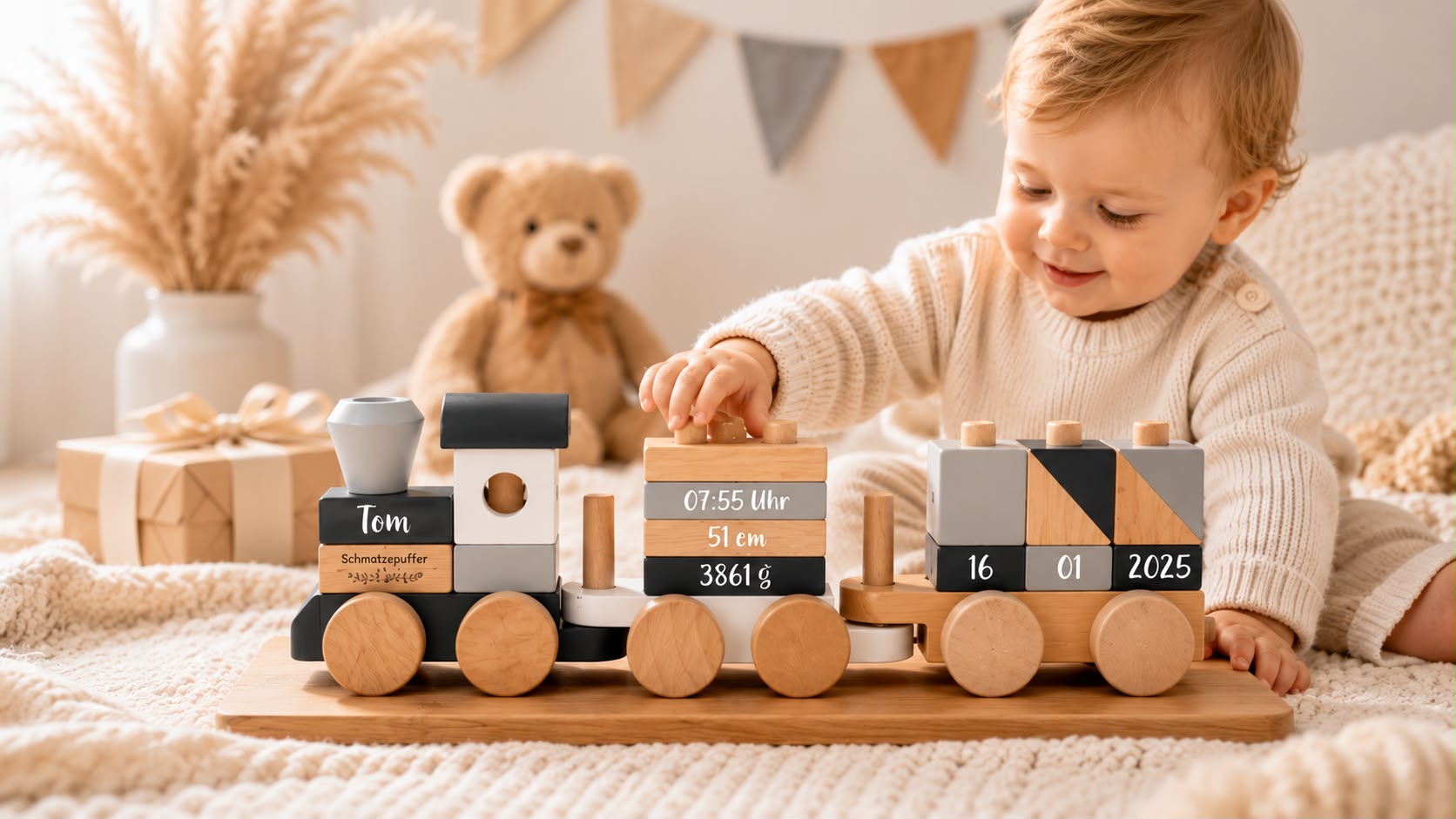
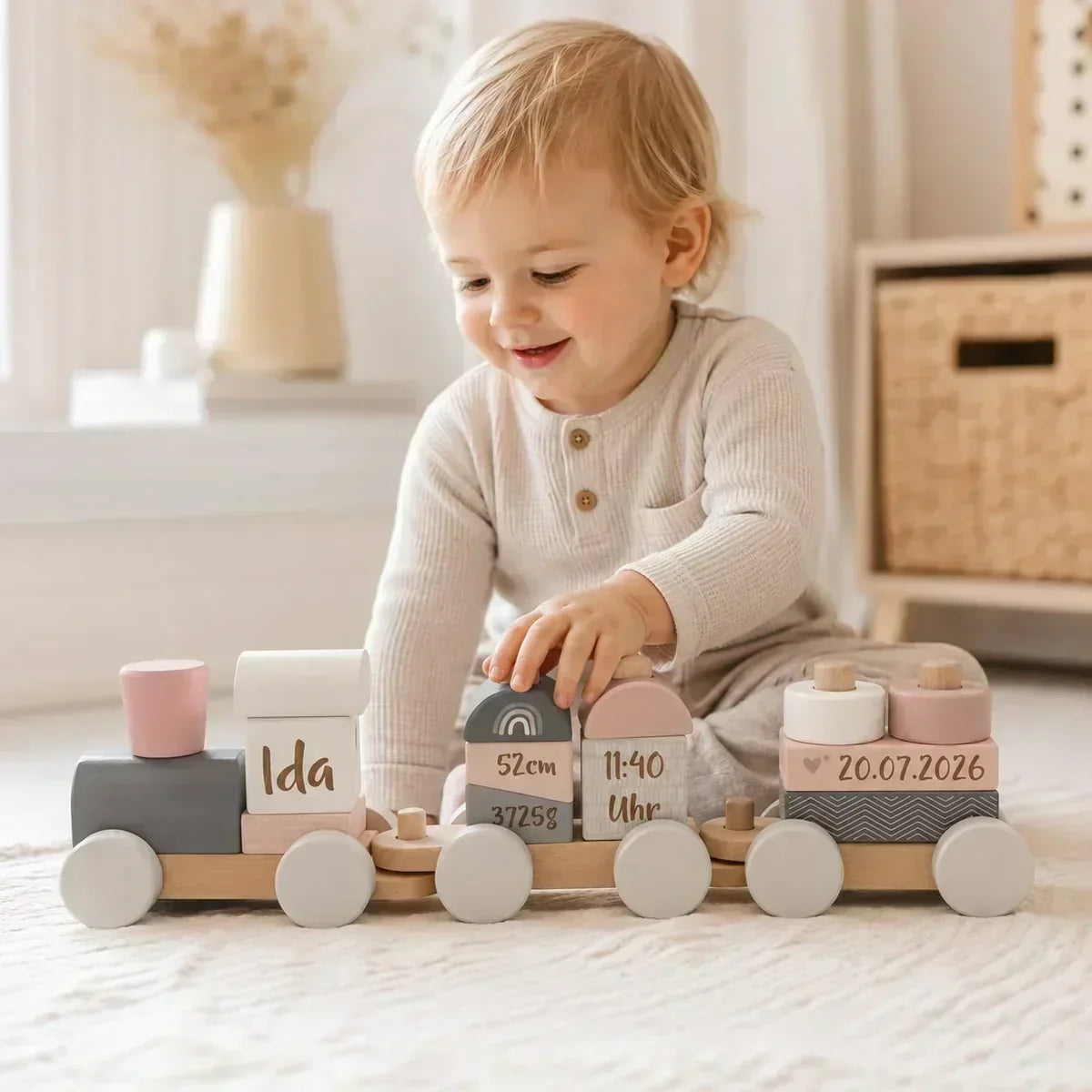
Many parents are surprised how quickly the first weeks with a baby pass. That's why many families choose a personalized keepsake with the name, birth date, size, and weight.
Breastfeeding & Nutrition
11. How do I know if my baby is drinking enough?
Good signs include regular feeding, audible swallowing during breastfeeding, several wet diapers a day, alert moments, and appropriate weight gain. In the first few days, it's normal for everything to settle in. If your baby is very sleepy, feeds poorly, has few wet diapers, or you have an uneasy feeling, you should contact your midwife or pediatrician. Professional guidance is especially valuable in the beginning.
12. How often should a newborn feed?
Many newborns feed very frequently, often eight to twelve times or even more within 24 hours. Some babies feed regularly every two to three hours, while others have phases where they feed very frequently and then sleep longer. Both can be normal. The crucial factor is not just the time, but whether your baby seems well-nourished and is developing appropriately for their age.
13. Why does my baby constantly want to feed?
This can be so-called cluster feeding. In this situation, a baby wants to be at the breast repeatedly for several hours or feed frequently, especially in the evenings. Many parents then immediately think there isn't enough milk. However, in many cases, this behavior is normal and helps stimulate milk production. It's exhausting, but not automatically a problem. If you're unsure, have your midwife assess the feeding behavior and weight.
14. Do I need to give my baby extra water or tea?
In the first few months, a healthy baby usually doesn't need extra water or tea if they are breastfed or receive appropriate infant formula. Additional fluids can even be unfavorable if they replace milk feedings. In cases of extreme heat, illness, or uncertainty, you should talk to your midwife or pediatrician.
15. Is formula worse than breast milk?
Breast milk has many benefits, but not every breastfeeding journey is straightforward. Some mothers cannot breastfeed, choose not to breastfeed, or need a combination of breastfeeding and bottle-feeding. The important thing is: a well-nourished baby and a stable mother are crucial. No one should have to feel ashamed for using formula. If you are bottle-feeding, ensure proper preparation, hygiene, and calm, needs-oriented feeding.
16. Why does my baby fall asleep while feeding?
Newborns get tired quickly. Feeding is strenuous for them, especially in the first few days. Sometimes it helps to gently wake the baby, change positions, or change their diaper before feeding. However, if your baby is consistently too sleepy, feeds poorly, or is difficult to rouse, you should seek medical advice. Especially in very young babies, poor feeding is an important warning sign.
17. Is frequent spitting up normal?
Small amounts of spitting up are normal for many babies. Their stomach is still small, and the transition to the esophagus is still immature. If your baby is gaining weight well, seems content, and only spits up small amounts, there's usually no cause for concern. It's different with projectile vomiting, poor weight gain, greenish vomit, blood, extreme fussiness, or refusing to feed. In these cases, you should have it checked by a doctor.
18. What helps with engorgement?
For engorgement, rest, frequent and correct latching, warmth before feeding, and cooling afterward can help. It's important that the breast is well emptied without rough squeezing. If you have a fever, severe pain, red hot spots, or feel generally unwell, you should seek medical advice promptly, as mastitis can develop.
19. Can I have too little milk?
Yes, there are situations where the milk supply is insufficient. More often, however, mothers are uncertain because the baby wants to feed often or is fussy. Frequent feeding does not automatically mean too little milk. Weight development, diapers, feeding behavior, and general condition should be considered together. A midwife or lactation consultant can quickly determine if action is truly needed.
20. What do I do for sore nipples?
Sore nipples are often a sign that the baby is not latching optimally or that the nipple is under significant strain. You don't have to simply endure severe pain. Often, small corrections to the latching technique, different feeding positions, air exposure for the breast, breast milk on the skin, or appropriate care can help. If bleeding, deep cracks, or severe pain occur, seek support.
Sleeping & Falling Asleep
21. Why does my baby only sleep on me?
Many babies sleep particularly well on a person's body because they feel warmth, scent, breathing, and heartbeat. This provides security. However, it can still be very exhausting for you if putting them down is barely possible. Important: If you yourself become tired, your baby should be placed in a safe sleep environment. For unsupervised sleep, the recommendations are back sleeping, a firm mattress, and a clear bed without pillows, blankets, or stuffed animals.
22. When do babies sleep through the night?
This varies greatly. In the first few months, frequent waking is normal because babies are hungry, need closeness, or need help falling back asleep. Sleeping through the night is not a sign of good parenting, and frequent waking is not a parental failure. Sleep matures over time. Helpful strategies include quiet nights, low light, soft voices, and realistic expectations.
23. How does a baby sleep safely?
A baby sleeps safest on their back, on a firm mattress, without pillows, blankets, bumper pads, sheepskins, or stuffed animals in the bed. A well-fitting baby sleeping bag is usually safer than a loose blanket. The sleeping area should not be overheated, and the airways must remain clear. These recommendations are important, even if babies often fall asleep more easily in your arms or on your chest.
24. Can my baby sleep in the parents' room?
Yes. A separate safe sleeping place in the parents' room is practical for many families and is often recommended. This way, you are close to your baby, can react more quickly, and don't have to walk far at night. It's important that your baby is lying safely and doesn't accidentally slip between pillows, blankets, or adults.
25. Why does my baby wake up immediately when put down?
The transition from body contact to the mattress is clearly noticeable for babies. One moment it was warm, close, moving, and familiar – suddenly it's quieter, cooler, and more open. Slowly putting them down can help: first wait until your baby is in a deeper sleep, then slowly place them down, leave one hand briefly on their chest or belly, and reduce stimuli. Nevertheless, it's normal if putting them down doesn't always work.
26. Is nursing to sleep okay?
Yes. Nursing to sleep is very normal in the first weeks and months. Sucking is calming, closeness provides security, and many babies find it easier to fall asleep this way. You don't have to be convinced that you are automatically creating bad habits. If it works for you, it's fine. If it's bothering you, you can gently introduce other sleep associations later.
27. How much sleep does a newborn need?
Newborns sleep a lot overall, but often in short bursts. Some seem to sleep constantly, while others appear more alert and restless from the start. It's important that your baby feeds regularly, has alert phases, and seems well cared for. If your baby is rarely awake, feeds poorly, or seems unusually listless, you should have it checked.
28. Why does my baby confuse day and night?
The day-night rhythm develops gradually. In the womb, there was no clear distinction between light and dark. You can gently support your baby by having daylight, normal noises, and activity during the day, and keeping everything quiet, dark, and low-stimulus at night. Nevertheless, it takes time for a more stable rhythm to develop.
29. Should I wake my baby during the day?
That depends on their age, weight, feeding behavior, and medical situation. Some babies need to be woken for feeds in the first few days, especially if they are very sleepy or have weight issues. Others can sleep if they are feeding well and developing properly. For newborns, this question should ideally be discussed with a midwife or pediatrician.
30. What helps with restless nights?
Helpful strategies include low light, soft voices, quiet diaper changes, as few stimuli as possible, and lots of closeness. Try not to let long awake phases with play or entertainment occur at night. Sometimes, fixed small routines help: breastfeed or bottle-feed, change diaper, cuddle, go back to sleep. Nevertheless, nights with a baby remain unpredictable. The goal is not perfection, but as much peace as possible for everyone.
Crying, Tummy Aches & Soothing
31. Is a lot of crying normal?
Crying is a baby's most important language. It can signal hunger, tiredness, a need for closeness, cold, warmth, a full diaper, tummy pressure, or overstimulation. A lot of crying can be an enormous strain on parents. If your baby cries shrilly, unusually, or inconsolably, feeds poorly, has a fever, or you feel something is wrong, you should seek help. And very importantly: If you can't cope anymore, safely put your baby down and call for support.
32. Why does my baby cry a lot in the evenings?
Many babies are fussier in the evenings. They are processing the day's stimuli, are tired, and need extra closeness. Cluster feeding also often occurs in the evenings. It helps to make the evening calmer: fewer visitors, dimmed lights, soft voices, carrying, breastfeeding, or feeding on demand. Evening crying is common, but it's still okay for it to bother you. You don't have to go through it alone.
33. What helps with tummy aches?
For tummy aches or gas, carrying, warmth, gentle clockwise belly massage, bicycle movements with the legs, and a calm posture can help. Sometimes a burp after feeding also provides relief. If your baby has a hard belly, cries very intensely, develops a fever, vomits, has blood in their stool, or feeds poorly, you should consult a doctor.
34. What are three-month colic?
The term "three-month colic" is often used when babies cry a lot, especially in their first months of life. Previously, this was primarily thought to be due to stomach pain. Today, we know that sensory processing, fatigue, regulation difficulties, and adaptation to the new world can also play a role. This phase is extremely exhausting for parents. Therefore, support is important – not only for the baby, but also for you.
35. Can I spoil my baby?
No. A newborn cannot be spoiled by closeness, carrying, breastfeeding, cuddling, or quick responses. This teaches them: My needs are seen. I am safe. This strengthens attachment and trust. Later, needs and boundaries change, but in the first few weeks, closeness is a basic need, not a bad habit.
36. What to do if my baby cannot be calmed down?
Go step by step: Is your baby hungry? Is the diaper full? Is it too hot or too cold? Is it tired or overstimulated? Does it need closeness, quiet, or a burp? Carrying, rocking, quiet humming, skin-to-skin contact, or a calm room can help. If you feel like you're about to explode, place your baby safely in their bed and immediately seek help. A baby must never be shaken.
37. Why does my baby only calm down with me?
You are particularly familiar to your baby. They know your smell, your voice, your heartbeat, and your way of holding them. This can be wonderful, but also very stressful if you don't get a break. Try to involve other caregivers anyway. Sometimes it takes time for a baby to calm down with dad, grandma, or another familiar person.
38. Can I carry my baby constantly?
Yes, if carried safely. Many babies need a lot of physical contact, especially in the first few weeks. Make sure your baby can breathe freely, doesn't slump, and doesn't overheat. Carrying can also help you because you can move and your baby still gets closeness. If your back or pelvic floor is strained, also pay attention to your own body.
39. Is a pacifier useful?
A pacifier can help some babies calm down because sucking fulfills a strong need for comfort. Other babies reject it. If you are breastfeeding and there are latching problems, it may be helpful to seek breastfeeding consultation first. It's important not to use the pacifier as the only answer to every signal, but to continue to take hunger, closeness, fatigue, and discomfort seriously.
40. What do I do if I can't cope anymore?
This is one of the most important questions. If you feel angry, desperate, or about to lose control: Place your baby safely on their back in their bed, leave the room for a moment, take a deep breath, and call someone. This is not failure, but protection. Please never shake a baby. Even a brief shake can cause life-threatening injuries. Get help early, before you reach your limit.
Health & Development
41. When should I take my baby to the pediatrician?
Of course, for the scheduled preventive check-ups, but also whenever your baby seems unusual. Warning signs include poor feeding, extreme sleepiness, breathing problems, pale or bluish skin, fever, hypothermia, high-pitched crying, or if you as a mother or father have the feeling: Something is not right. With newborns, it's better to ask too early than too late.
42. What are the U-examinations?
The U-examinations are important preventive check-ups for babies and children. They check growth, reflexes, organs, development, senses, and general health. For parents, these appointments are also a good opportunity to ask questions: about breastfeeding, sleeping, crying, weight, skin, umbilical cord, digestion, or their own insecurity. It's best to write down your questions beforehand.
43. Is jaundice normal in babies?
Mild newborn jaundice is common because the baby's body breaks down certain blood components after birth. Nevertheless, jaundice should be monitored. If your baby appears very yellow, is very sleepy, feeds poorly, or the yellowing increases, you should have it checked by a doctor. Especially in the first few days of life, assessment by a midwife or pediatrician is important.
44. When is fever dangerous?
In newborns and very young babies, fever should always be taken seriously. Hypothermia, poor feeding, extreme sleepiness, or a poor general condition can also be warning signs. Please do not simply treat a young baby yourself with home remedies or medication, but contact a pediatrician, on-call service, or, in an emergency, the ambulance service.
45. How do I know if my baby is sick?
Typical warning signs include poor feeding, unusual sleepiness, breathing problems, bluish lips, fever, hypothermia, projectile vomiting, very high-pitched crying, extreme restlessness, seizures, or an unusually limp body. Even if you can't pinpoint it, but your gut feeling tells you something is wrong, you should seek help. Parents often notice changes very early.
46. Why does my baby sneeze so often?
Sneezing is common in newborns and usually normal. Babies clear their noses this way because they cannot yet blow them. Dry air, dust, or milk residue can also irritate. If fever, coughing, breathing problems, poor feeding, or severe congestion also occur, you should have it checked.
47. How many diapers are normal?
The number of wet diapers changes in the first few days because the milk supply also increases. After milk comes in, several wet diapers daily are a good sign. Stool also changes: from dark meconium to greenish and later yellowish varieties. If your baby has hardly any wet diapers, is very sleepy, or feeds poorly, you should ask for advice.
48. When can I take my baby for a walk?
If you and your baby are doing well, short walks are usually possible early on. Fresh air can be good, even for you in the postpartum period. Pay attention to appropriate clothing, shade in summer, protection from cold in winter, and avoid overheating. Large crowds or long excursions are not necessary at the beginning. A small walk is perfectly sufficient.
49. Do I have to stimulate my baby?
In the first few weeks, your baby doesn't need special learning programs. The best stimulation is closeness, eye contact, your voice, gentle carrying, loving care, and short awake moments in tummy time under supervision. Your baby learns through everyday life: changing diapers, talking, cuddling, breastfeeding or feeding. Less overstimulation is often better than too much activity.
50. What will remain in memory from this time later?
Often it's not the perfect days, but small moments: the first smile, tiny hands, the baby's scent, the first photos, a hospital wristband, the first hat, or a gift with name and birth data. Many families consciously preserve these memories – in a memory box, in pictures, or with personalized gifts for birth. Precisely because the first period passes so quickly, such mementos later become particularly valuable.
The most beautiful memories begin today
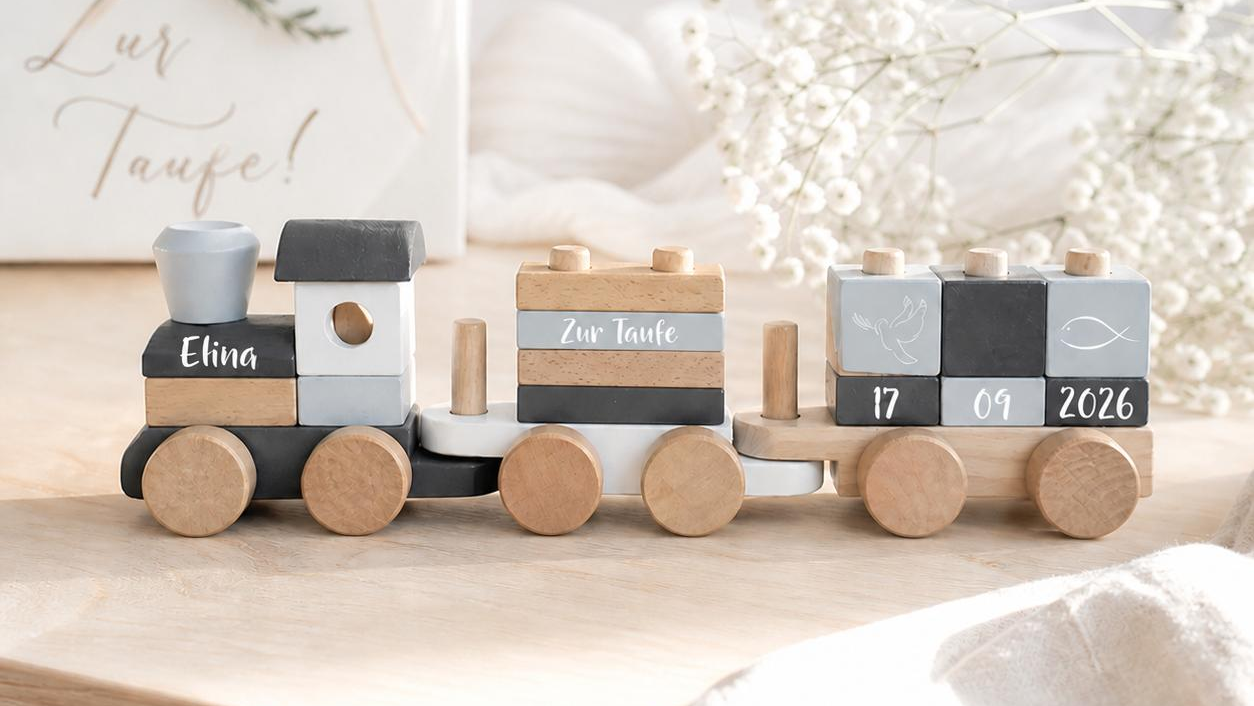
Many families preserve their child's most important birth data on a personalized wooden train, a memory box, or a special birth gift.
50 more important questions after birth – Part 2
After the first few weeks are over, new questions often arise. Many parents are now concerned with development, everyday life, sleep, complementary feeding, bonding, and their baby's first major milestones.
Development & Growth
51. Is my baby growing fast enough?
One of the most common concerns for new parents is: "Is my baby gaining enough weight?" or "Is my baby growing as they should?". In fact, every baby develops individually. Some babies gain weight quickly in the first few weeks, while others grow in smaller steps.
What is crucial is not a single measurement on the scale, but long-term development. Pediatricians therefore assess weight, height, and head circumference over a longer period and compare these with age-appropriate growth curves.
Good signs are regular wet diapers, age-appropriate weight gain, awake phases, and an overall contented impression. If your baby seems very sleepy, feeds poorly, or gains little weight, you should contact your midwife or pediatrician.
Important to know: Comparisons with other babies are rarely helpful. Every child brings their own genetic predisposition and develops at their own pace.
52. Why does my baby suddenly seem unhappy?
Many parents experience phases where their baby suddenly becomes much clingier, fussier, or more restless overnight. Often, this is not a health problem, but a normal developmental phase.
Babies process countless new impressions every day. The brain develops rapidly in the first months of life. New sounds, faces, movements, and sensory impressions need to be processed. As a result, your baby may temporarily need more closeness, more sleep, or more frequent feeding.
Growth spurts, teething, fatigue, or changes in daily routine can also lead to more restlessness. It often helps to make the day a bit calmer, reduce stimuli, and give your baby extra closeness.
However, if the unhappiness is accompanied by fever, poor feeding, vomiting, or other noticeable symptoms, you should seek medical advice.
53. What is a developmental leap?
Many parents use the term developmental leap to describe a phase in which their baby suddenly develops new skills and at the same time becomes significantly clingier or more restless.
During a developmental leap, the brain processes new impressions and builds new connections. For example, your baby consciously recognizes faces, begins to grasp objects, or perceives sounds more intensely.
Typical signs can be:
- more frequent breastfeeding or feeding
- restless sleep
- more crying than usual
- stronger need for closeness
- sudden new abilities
Developmental leaps are usually temporary. Even if they can be exhausting, they often show that your baby is making important developmental steps.
54. When does my baby start to smile consciously?
The first conscious smile is one of the most emotional moments in the first weeks of a baby's life. Many babies show their first social smile between the sixth and eighth week of life.
Before that, there are often so-called reflex smiles, which usually occur during sleep. The social smile differs in that your baby consciously reacts to your face, your voice, or your attention.
When your baby smiles at you, they begin to actively communicate with you. This moment enormously strengthens the bond between parent and child and is never forgotten by many families.
If your baby smiles a little later, it is usually no cause for concern. Development does not proceed at the same pace for every child.
55. When does my baby recognize me?
Even shortly after birth, your baby recognizes familiar voices and smells. They already know their mother's voice from pregnancy.
In the first few weeks, the face also becomes increasingly important. Babies prefer faces over other shapes and quickly learn to recognize familiar people.
Many parents notice that their baby calms down more quickly with them than with other people. This is because your baby already knows your voice, your smell, and your movements and associates them with security.
This early bond forms the basis for trust, emotional security, and healthy development.
56. When does my baby start grasping?
The first deliberate grasping movements usually develop between the third and fifth month of life. Before that, babies often move their hands uncoordinatedly.
First, your baby discovers their own hands. They look at them, bring them to their mouth, and gradually learn to control movements purposefully.
Grasping is an important developmental step because it allows them to actively explore the world. Suitable rattles, soft toys, or age-appropriate wooden toys can support this development.
Every child develops this ability at their own pace. Small differences are completely normal.
57. Is every baby equally fast?
No. Development never proceeds at the same pace for all children. Some babies roll over early, others speak their first words later, or sleep for longer periods earlier.
Parents often compare their child with other babies from their circle of friends or social media. This often leads to unnecessary uncertainty.
What is crucial is not whether your baby can do something earlier or later, but whether the overall development is consistent. Regular preventive examinations help to assess this professionally.
58. Do I have to keep my baby occupied?
Many parents believe they have to constantly stimulate or occupy their baby. In reality, babies primarily need closeness, security, and everyday experiences in the first few months.
Your voice, your face, walks, cuddling, changing diapers, or observing the surroundings together are already valuable learning opportunities.
Babies learn through repetition and relationships. Constant overstimulation from toys, music, or activities can even be counterproductive. Often, less is more.
59. When does my baby start to laugh?
Many babies first laugh consciously between the third and fourth month of life. While the first social smile is more of a reaction to closeness and attention, real laughter already shows a much more active form of communication.
Particularly familiar voices, funny sounds, facial expressions, or small games often trigger the first fits of laughter.
For many parents, this first laugh is one of the most beautiful memories of babyhood. It shows that your baby is interacting with their environment more and more consciously.
60. When will my baby become more mobile?
With increasing head control, an exciting phase begins for your baby. They first learn to hold their head, then to roll, turn, crawl, and finally to creep.
Each of these developmental steps opens up new possibilities to discover the world. That's why many babies suddenly seem more curious, active, and sometimes more restless.
It is important to give your baby sufficient safe opportunities to move. A playmat on the floor often offers better developmental opportunities than hours of sitting in bouncers or other aids.
How quickly a baby moves varies greatly. Some children crawl early, others skip individual developmental steps and still walk completely normally later.
Bonding & Parenthood
61. How do I know if I'm a good mother?
Almost all mothers ask themselves this question at some point – often several times a week. Especially in the first months after birth, doubts quickly arise: Am I doing enough? Am I reacting correctly? Should I have done something differently?
The good news is: The very fact that you ask yourself this question already shows how important your child is to you. A good mother is not recognized by doing everything perfectly. A good mother tries to perceive her baby's needs, respond to them, and give her child love, security, and comfort.
Babies don't need perfect parents. They need people who are there, listen, comfort, and always try to understand their child. Mistakes are part of it. What matters is not perfection, but reliability and love.
62. Is insecurity as a mother or father normal?
Yes, absolutely. Even parents with several children repeatedly experience situations where they are insecure. Every baby is different and brings new challenges.
Many new parents compare themselves to other families or to images from social media. There, much seems easier than it actually is. In reality, almost all parents have questions, doubts, and difficult days.
Insecurity does not mean you are unsuitable. Rather, it shows that your child is important to you. Over time, you will get to know your baby's signals better and automatically gain more confidence in your own abilities.
63. Why do I doubt myself so often?
Parenthood fundamentally changes life. Suddenly you are responsible for a small human being who is completely dependent on you. This responsibility can feel overwhelming.
In addition, lack of sleep, hormonal changes, physical exhaustion, and societal pressure play a major role. Many parents feel they constantly have to do everything right.
Important to know: Doubts do not make you a bad mother or father. They are a normal part of becoming a parent. However, if the doubts become very strong persistently or you feel worthless, you should seek support from a midwife, doctor, or counseling services.
64. What does my baby need most?
Many parents buy numerous products before birth and later wonder what their baby really needs. The answer is surprisingly simple: love, security, food, sleep, and reliable caregivers.
Your baby doesn't need a perfect daily schedule, expensive toys, or constant entertainment. Much more important are closeness, physical contact, loving responses, and people who respond to their needs.
When your baby experiences someone coming when they cry, comforting them, feeding them, and protecting them, trust develops. This trust forms the foundation for healthy emotional development.
65. Do I have to constantly talk to my baby?
You don't need to maintain a continuous conversation. Nevertheless, your voice is incredibly important for your baby's development. Even simple everyday sentences help your child learn language.
You can tell your baby what's happening: "Now we're changing your diaper," "We're going for a walk," or "You're tired." It's not about imparting knowledge, but about making language tangible.
Babies learn language primarily by listening. Your voice conveys security and simultaneously strengthens the bond. Therefore, normal everyday speech is often more valuable than any special educational program.
66. Is skin-to-skin contact important?
Yes. Skin-to-skin contact plays an important role in the bond between parents and child. Many babies calm down immediately when they lie directly on their mom's or dad's skin.
The heartbeat, body warmth, and familiar scent convey security. Especially after birth or during restless phases, skin-to-skin contact can help reduce stress.
Parents also benefit. Many report feeling closer to their baby through skin-to-skin contact and being better able to perceive their baby's needs.
67. Can I spoil my baby?
Midwives and pediatricians have been hearing this concern for decades. The answer is: No. A newborn cannot be spoiled by closeness, carrying, cuddling, or quick reactions.
Babies don't cry to manipulate adults. They cry because they are hungry, need closeness, are tired, or need help. When you respond to these signals, your baby learns that the world is a safe place.
Especially in the first months of life, closeness is not a bad habit, but a basic need.
68. Why does my baby always want to be with me?
For your baby, you are the most familiar person in the world. They already know your voice, your smell, your movements, and your heartbeat from pregnancy.
The world outside the womb is new, loud, and full of impressions. That's why many babies seek their parents' closeness particularly often. In their arms, they feel safe and protected.
This behavior is completely normal and not a sign that your baby will become dependent later. On the contrary: a secure attachment promotes self-confidence and independence in the long run.
69. What is attachment exactly?
Attachment describes the emotional relationship between a child and their most important caregivers. It doesn't arise from a single moment, but from many small experiences in everyday life.
When your baby is hungry and fed, cries and is comforted, or is scared and gets closeness, they learn: Someone cares about me. I am safe.
These experiences shape a child's trust in the world and in other people. That's why a stable attachment is so important for emotional development.
70. Do I have to be perfect?
No. Perfection is neither possible nor necessary. Many parents put enormous pressure on themselves and believe they shouldn't make any mistakes.
However, babies don't need perfect parents. They need people who love them, who are there, and who constantly try to understand their needs.
There will be days when you are tired, react irritably, or doubt yourself. That doesn't make you a bad mother or father. What matters is the loving basic attitude over time.
Daily life with baby
71. When does daily life with a baby get easier?
Many parents hope for the moment when everything suddenly becomes easier. The truth is: daily life is constantly changing. However, most families gain significantly more confidence after a few weeks.
You get to know your baby's signals better, find your own routines, and develop confidence in your abilities. This makes many things feel less chaotic.
Nevertheless, there are always new challenges. Developmental leaps, teething, or sleep phases bring changes. But with every mastered phase, your experience also grows.
72. How do I manage housework and baby at the same time?
Many parents quickly realize that housework and baby don't always work simultaneously. Caring for a baby is already a full-time job.
Therefore, you are allowed to set priorities. A fed baby, enough sleep, and your own well-being are more important than a perfectly tidy living room.
If help is offered, accept it. Shopping, cooking, or laundry can often be taken over by others. You don't have to do everything alone.
73. Why do I not get anything done anymore?
Many mothers feel at the end of the day that they haven't accomplished anything. In reality, they have usually spent the entire day caring for a baby, feeding, changing, carrying, comforting, and accompanying them.
These tasks are often invisible but incredibly valuable. Caring for a baby consists of many small activities that are constantly repeated.
If you feel like you haven't accomplished anything, remember: caring for your baby is already a great achievement.
74. Am I allowed to accept help?
Yes. Accepting help is not a sign of weakness, but of responsibility. No one has to cope with the first period with a baby alone.
Friends, family, or neighbors can help with shopping, cooking, or cleaning. Often people want to help, but don't know how.
The more specific your request, the easier it is for others to help. Instead of "Can you do something?", it's better to say: "Can you bring us something to eat tonight?"
75. What can I prepare to avoid stress?
Many families benefit from preparing a few things before the birth. This includes pre-cooked meals, enough diapers, an organized changing station, and important phone numbers.
However, even more important than practical preparation is a realistic expectation. The first weeks with a baby are rarely predictable. Not everything has to go perfectly.
Those who accept that chaos, fatigue, and uncertainty are part of it often experience the initial period much more relaxed. Focus on the essentials: your baby, your recovery, and your shared bond.
Out and about with baby
76. How important are routines for my baby?
Many parents wonder whether they should establish fixed routines as early as possible. In fact, recurring routines can provide babies with security and orientation. Especially in the evenings, small rituals often help to facilitate the transition from an active day to a quiet night.
It is important, however, that routines are not confused with rigid schedules. Newborns initially orient themselves not by the clock, but by their needs. Hunger, fatigue, the need for closeness, or developmental leaps can change any daily routine.
Helpful rituals can include a shared bath, putting on a sleep sack, a calm song, or dimmed lights. Such recurring routines convey familiarity and security to your baby.
If a routine doesn't work sometimes, that's completely normal. A baby doesn't need perfect structure, but loving guidance.
77. Does my home have to be perfectly tidy?
Many parents put enormous pressure on themselves after birth. The household should be tidy, visitors want to be received, and at the same time, the baby needs round-the-clock attention.
The truth is: a loving home is much more important than a perfect household. Your baby is not interested in dust-free shelves or perfectly folded laundry.
In the first few months, you are allowed to set priorities. Food, sleep, rest, and caring for your baby are more important than an immaculate living room.
Many parents even report later that they wish they had spent less time tidying up and more time cuddling.
78. How much sleep do I need myself?
Lack of sleep is one of the biggest challenges for many parents in the first few months. Even a few nights with frequent interruptions can significantly affect concentration, mood, and resilience.
Therefore, you should use every opportunity for rest. Even short periods of rest during the day can help recharge your energy.
Try to delegate tasks and accept help. Not every free minute has to be used productively. Sleep is not a reward, but a basic need.
If you are constantly exhausted, feel overwhelmed, or feel like you are reaching your emotional limits, you should openly talk to your partner, midwife, or doctor.
79. How can my partner help?
Many people think support primarily means holding the baby briefly. In fact, there are many more ways to relieve a family after birth.
Practical help can mean:
- Cooking meals
- Doing laundry
- Going grocery shopping
- Providing night-time support
- Organizing or limiting visitors
- Caring for siblings
- Providing emotional support
Even if only one person breastfeeds, both parents can actively take responsibility. The first period with a baby usually works best as teamwork.
80. When can I think about myself again?
Many parents completely put their own needs aside after birth. However, self-care is not selfishness, but an important prerequisite for being able to be there for your baby in the long run.
Self-care doesn't have to be grand. Often, small moments are enough: a warm shower, a walk, a quiet cup of coffee, or a short chat with friends.
The better you feel, the more strength you have for your child. Therefore, you are allowed to take your own needs seriously.
81. When can I travel with my baby?
Many families want to go on excursions or trips as quickly as possible. In principle, there is often nothing against short trips if mother and baby are doing well.
However, it is important to have realistic expectations. Traveling with a baby requires more planning, more breaks, and significantly more flexibility.
For the first outings, short trips and simple destinations are usually better than long journeys with a full schedule. This allows parents and baby to gradually get used to new situations.
82. What should be in the diaper bag?
A well-packed diaper bag can avoid a lot of stress on the go. The most important basic equipment includes:
- Diapers
- Wet wipes or washcloths
- Changing pad
- Change of clothes
- Burp cloth
- Pacifier (if used)
- Milk or breastfeeding supplies
- Garbage bags
- Drink for the parents
With increasing experience, you will quickly notice which items you really need regularly.
83. How long can my baby lie in the stroller?
A stroller is a practical option for walks and excursions. Nevertheless, a baby should not spend the entire day in it.
Babies benefit from different positions, closeness to their caregivers, and sufficient freedom of movement on a safe surface.
For walks, the stroller is ideal. However, if your baby spends a longer time in it, regular breaks are advisable.
Many babies also enjoy alternating between the stroller, carrier, and cuddle time on a play mat.
84. Is driving stressful for babies?
Yes. Even if many babies fall asleep in the car, driving can be strenuous. The infant car seat is an important safety place, but it offers only limited movement possibilities.
For longer journeys, you should plan enough breaks. These can be used for changing diapers, feeding, carrying, and taking a breath.
Try to make longer journeys as relaxed as possible. A realistic schedule reduces stress for parents and child alike.
85. When can my baby go to the beach?
Fresh air and the sound of the sea can also be pleasant for babies. Nevertheless, young babies need special protection from sun, wind, and heat.
Direct sun exposure should be avoided as much as possible. A shady spot, light clothing, and regular drinking breaks are particularly important.
Many families choose morning or evening hours for beach visits, as sun exposure is significantly lower then.
Are you still looking for a gift for the birth?
Many families want to capture the first weeks of their baby forever. Personalized gifts with name, date of birth, size, weight, or time create memories that often last for many years.
At Schmatzepuffer, personalized baby gifts are made directly for the respective family. This creates unique keepsakes for birth or baptism.
86. How do I protect my baby from the sun?
The most important sun protection for babies is shade. Especially young babies should be exposed to direct sunlight as little as possible.
Light clothing, headwear, and a shady spot often offer the best protection. Also, make sure your baby doesn't overheat.
Especially in summer, it's worth planning walks for the morning or evening hours.
87. Can my baby swim?
Baby swimming can be a wonderful shared experience. It's not about learning to swim, but about playfully getting to know water.
Important factors are comfortable water temperatures, short sessions, and observing your baby's signals. If your child is cold, tired, or restless, the activity should be stopped.
Fun and shared time are always paramount.
88. How many appointments are reasonable?
Many parents want to juggle family, friends, courses, and doctor's appointments. Especially in the first few months, however, less is often more.
Babies process new impressions intensely. Too many appointments can lead to restlessness and overstimulation.
Consciously plan rest periods and pay attention to how your baby reacts to outings or visits. Not every day has to be packed.
89. How do I recognize overstimulation in my baby?
Babies often show very clearly when something is too much for them. Typical signs can be:
- Looking away
- Yawning
- Fussing
- Crying
- Frantic movements
- Trouble falling asleep
If you notice such signals, it often helps to reduce stimuli, leave the room, or give your baby more closeness and quiet.
90. When will my baby become more curious?
With every developmental step, your baby discovers more of their surroundings. They follow movements, observe faces, listen to voices, and become increasingly interested in objects.
This growing curiosity is an important part of development. Your baby is constantly learning and beginning to actively interact with their environment.
You don't need to offer special programs for this. Loving conversations, shared walks, and everyday experiences are often completely sufficient to foster natural curiosity.
Gifts, memories & special moments
91. What is a good gift for a birth?
A good gift for a birth is more than just a pretty product. It should either make the young family's daily life easier or create a lasting memory. Many parents receive clothes, cuddly toys, or practical items for the birth. However, gifts that have a personal connection to the child become particularly valuable.
Personalized gifts with a name, date of birth, time of birth, size, or weight are therefore among the most popular gift ideas for a birth. They will still remind them many years later of the special day when a new life began.
High-quality keepsakes that later find a permanent place in the nursery or family life are particularly appreciated. This is precisely why personalized wooden trains, memory boxes, or individual wooden toys are very popular.
92. Why are personalized gifts so popular?
Personalized gifts tell a child's story. While many products are interchangeable, a personalized item with a name and birth date is unique.
For parents, this often creates a very special emotional connection. The gift not only commemorates the birth but also the first days, the first memories, and the joy of the new family member.
That's why personalized gifts are often kept for years and not discarded like many other baby items.
93. What memories should I save from infancy?
Many parents later regret not the things they kept, but the memories that were lost. That's why it's worth consciously preserving important moments.
Popular keepsakes include:
- the hospital bracelet
- the first hat
- first socks
- ultrasound images
- birth announcements
- christening cards
- special photos
- a lock of hair
- the first hand or foot prints
Many families collect these memories in a memory box so they can be easily found later.
94. What remains particularly valuable later on?
With some distance, it is rarely the most expensive purchases that hold the greatest significance. Memories, photos, and personal items usually become particularly valuable.
Many parents report that years later, it is primarily the small things that move them: a photo from the first few days, the first clothes, or a gift with their child's name.
Precisely for this reason, keepsakes are often preserved for decades and later even passed on to the children.
95. What do grandparents especially like to give for a birth?
Grandparents often look for gifts with emotional value. They want to give something that not only brings short-term joy but also retains long-term significance.
Therefore, high-quality keepsakes, personalized gifts, and durable wooden toys are among the most popular gifts from grandma and grandpa.
Many grandparents want to show with their gift: You are an important part of our family. Personalized gifts are particularly well-suited for this.
96. What is suitable as a christening gift?
A good christening gift often accompanies the child for many years. While some families prefer religious gifts, others prefer personal keepsakes.
Particularly popular are:
- personalized memory boxes
- wooden trains with names
- individual wooden toys
- gifts with christening dates
- special keepsakes for the nursery
A christening gift should be as timeless as possible and remain a beautiful reminder of this special day later on.
97. What do you give to parents who already have everything?
Many families already own strollers, clothes, and the most important baby equipment. Therefore, personal gifts are often much more meaningful than more standard products.
A gift with a name or birth date shows that you put thought into it and didn't just buy any item.
Especially personalized gifts create an emotional value that cannot simply be bought in the next store.
98. Why are memory boxes so popular?
A child's first years are full of small memories. Without a designated place, many of them get lost or disappear into drawers and boxes.
A memory box offers the opportunity to safely store important moments. Many families collect birth announcements, photos, first clothes, or other personal memories in it.
Memory boxes look particularly nice when they are individually personalized with names or birth dates.
99. What is a gift that lasts many years?
The best gifts grow emotionally with you. While some products are no longer used after a few months, high-quality keepsakes often last a lifetime.
These include, for example:
- personalized wooden trains
- memory boxes
- high-quality wooden toys
- personalized plush toys
- special christening gifts
The actual value is not created by the material, but by the story associated with the gift.
100. Why are the first months so special?
The first months with a baby are a time full of changes. The first smile, the first sounds, the first walks together, and the first family photos create memories that often accompany parents throughout their lives.
At the same time, this period usually passes more quickly than one thinks at the time. Many parents later say: "We would have loved to experience exactly these moments again."
That's why it's worth consciously preserving memories – with photos, small mementos, and personal keepsakes that tell the story of this special phase of life.
Conclusion: The first months with a baby are unique
The first months with a baby bring new questions every day. That's completely normal. Nobody knows all the answers from the start. With love, patience, support, and the right information, confidence in one's own abilities grows step by step.
Many worries of the first few weeks are eventually forgotten. The memories remain. The first smile, the first nights together, the tiny hands, and all the special moments that change family life.
That's why many parents, grandparents, godparents, and friends choose personal keepsakes that capture this unique time. A gift with a name, birth date, size, weight, or time still tells the story of a very special day years later.
The first weeks pass. The memories remain.
Since 2011, Schmatzepuffer has accompanied families through the most beautiful moments of their lives. As a family-run business with many years of experience in birth, christening, and personalized gifts, we experience daily the importance of personal memories for parents, grandparents, and godparents.
Many of our personalized gifts are refined with names, birth dates, times, sizes, or weights and become keepsakes that often have a permanent place in the nursery or family life many years later.
- ✓ Personalized gifts for birth
- ✓ Memory boxes for valuable mementos
- ✓ Personalized wooden trains with birth data
- ✓ Individual baby gifts with names
- ✓ Special gifts for christening
We hope that this guide has been able to answer some of your questions. And if you haven't found all the answers today: that's perfectly fine. Nobody needs to know everything right away. Parenthood is not a competition, but a journey full of small and big moments that continues every day.
Enjoy your time together, trust your gut feeling, and get support when you need it. The first few weeks with your baby are unique – and often pass much faster than you think.